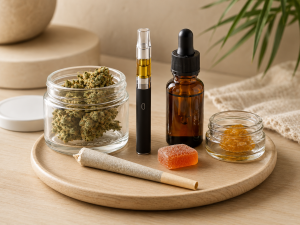

Only a portion of the THC in an edible actually makes it into your bloodstream, and that amount can vary a lot depending on the product and the person. The rest gets broken down during digestion, which is a big reason edibles can feel so unpredictable. You eat one, wait a while, feel nothing after 45 minutes, maybe take another, and then both hit you at once an hour later. That’s not bad luck — that’s just how edibles work.
The fast-acting edibles vs. regular edibles question comes up all the time at the counter here at Commencement Bay Cannabis, and it’s worth answering clearly because the difference is real. It comes down to chemistry, specifically how THC gets from your stomach into your bloodstream, and understanding that difference can help you choose the right product for the right situation.
Why Do Regular Edibles Take So Long to Kick In?
THC is fat-soluble, not water-soluble, which makes absorption in the digestive system a little tricky. Your gastrointestinal tract is mostly a water-based environment, so THC does not mix into it especially well on its own. Your body has to do more work to absorb it.
Once THC gets absorbed through the gut wall, it doesn’t go straight to your brain. It travels first to the liver in a process called first-pass metabolism before reaching general circulation. Your liver converts some of that THC into a metabolite called 11-hydroxy-THC, which is often described as more psychoactive and crosses the blood-brain barrier efficiently. That’s one reason edibles can feel heavier and last longer than smoking the same amount of flower.
It also helps explain why regular edibles typically take 30 minutes to two hours to kick in, and why effects can last four to six hours or longer once they do.
How Do Fast-Acting Edibles Work Differently?
Fast-acting edibles are designed to improve absorption, often by using a manufacturing process called nanoemulsion. Instead of leaving THC in its natural oily form, manufacturers break the oil down into very small droplets, often under 200 nanometers, and suspend them in a water-compatible emulsion. That is a genuinely different starting material than what goes into a regular edible.
Because those THC droplets are smaller and already emulsified for a water-based environment, your digestive tract can absorb them more quickly. Some products may even allow earlier absorption than a standard edible, though most still rely on digestion rather than direct absorption under the tongue. The result is that fast-acting edibles often kick in within 15 to 30 minutes, which is usually faster than a regular edible.
Is Nanoemulsion THC Really Water-Soluble?
Technically, not quite, and it’s worth being precise here because marketing language can get sloppy. True water solubility means a compound dissolves completely at the molecular level, like sugar in tea. Nanoemulsified THC is more accurately described as water-dispersible or water-compatible.
The oil droplets are so small they stay suspended more evenly instead of separating and floating on top the way regular THC oil would in a water-based drink or gummy. For consumers, the practical result is usually a faster onset and a more consistent experience than standard oil-based edibles.
Fast-Acting Edibles vs. Regular Edibles
The timing difference is big enough to matter when you’re planning your evening. A regular edible generally takes 30 to 120 minutes before you notice anything, with effects building gradually over the following hour and lasting four to six hours or more. A fast-acting edible using nanoemulsion or liposomal technology typically kicks in within 15 to 30 minutes and often has a shorter overall duration, usually around two to four hours.
That shorter duration is not necessarily a downside. It is a tradeoff. Faster onset often means a shorter overall experience, so the benefit is speed and convenience rather than a long, slow curve.
Bioavailability is the term that helps explain why the difference can feel so noticeable. It refers to the percentage of what you consume that reaches your bloodstream and has an effect. Regular, oil-based edibles often have relatively low and variable bioavailability because absorption can be limited by digestion and first-pass metabolism. Nanoemulsified products may improve absorption because the smaller droplets can be easier for the body to process.
That’s one reason a fast-acting product can sometimes feel stronger or more immediate milligram for milligram than a regular edible with the same labeled dose.
When to Use Fast-Acting Edibles
Timing matters most in social or scheduled situations. If you’re heading to a concert, a dinner, or any event with a set start time, a fast-acting edible lets you dose closer to when you actually want to feel something instead of guessing an hour and a half in advance. Someone planning to feel good for a two-hour show probably does not want the effects arriving halfway through the event.
Regular edibles still make more sense in plenty of situations. If you’re settling in for a full evening at home with nothing time-sensitive on the calendar, a slower onset and longer duration can mean fewer redoses and a more gradual experience. Medical patients managing chronic symptoms overnight often prefer that longer curve because it may reduce the need for redosing.
Do They Feel Different?
Many consumers describe fast-acting edibles as feeling clearer or more immediate, while regular edibles may feel heavier or more body-centered because of liver metabolism. Neither is objectively better for everyone. They just solve different problems and may suit different kinds of nights.
What matters most is matching the product to the plan. Fixed start times, social settings, and anything where you want predictable timing tend to point toward a fast-acting option. Open-ended evenings, longer sessions, or situations where you want a slower build often point toward a regular edible instead.
Picture two different Saturday nights. In the first, you’ve got dinner reservations at seven and want to feel relaxed and social by the time you sit down, without worrying about a delayed onset showing up halfway through the meal. A fast-acting gummy taken 20 to 30 minutes before you leave the house may line up better with that kind of schedule than a regular edible.
In the second scenario, you’re home for the night with nothing planned, maybe watching a movie or unwinding after a long week. There’s no deadline to hit, so the slower build and longer duration of a regular edible may fit naturally, and you may not need to redose as often.
Medical patients often land somewhere in between depending on what they’re managing. Someone using cannabis for sleep support might prefer a regular edible taken an hour or so before bed, since the longer duration can carry them through the night. Someone managing daytime pain around a specific activity, like a workout or a physically demanding shift, might lean toward a fast-acting product because they can time relief to when they actually need it.
Are Fast-Acting Edibles More Expensive?
Generally, yes, and there is often a real production reason behind it. Nanoemulsion often requires specialized equipment and a more involved manufacturing process than simply infusing oil into a standard gummy base. That extra step often shows up in the price.
Usually, the premium is modest rather than dramatic, and many customers find the predictability worth it, especially for anything time-sensitive.
What Are They Made Of?
Water-soluble and nanoemulsion products usually start with standard cannabis oil or distillate, the same base ingredient used in many regular edibles. The difference is what happens next. Manufacturers combine that oil with water and food-grade emulsifiers, then use mechanical processes like high-shear mixing or ultrasonication to break the oil into microscopic droplets.
Liposomal delivery is a related but distinct approach that uses lipid-based carriers to help THC move through the digestive system more efficiently. It aims for a similar result, but it uses a different structure than nanoemulsion.
None of this changes what THC is at its core. It changes how efficiently your body can access it, which is really the main story behind fast-acting edibles as a category.
How to Decide Between Them
A simple way to think about it is: match the product to the plan, not just the mood.
- Fixed start times, social settings, and anything where you want predictable timing point toward a fast-acting option.
- Open-ended evenings, longer sessions, or a slower build point toward a regular edible.
- Neither format is better across the board. They are built to solve different problems.
If you’re newer to edibles, starting with a low dose in either format and waiting the full expected onset window before taking more is one of the most useful habits you can build.
FAQ
What are fast-acting edibles?
Edibles made with nanoemulsion or similar technology that breaks THC oil into tiny, water-compatible droplets for faster absorption than standard oil-based edibles.
How long do fast-acting edibles take to kick in?
Typically 15 to 30 minutes, compared with 30 to 120 minutes for a regular edible.
What is nanoemulsion in cannabis edibles?
A manufacturing process that breaks THC oil into extremely small droplets and suspends them in a water-compatible emulsion for faster absorption.
How long do fast-acting edible effects last compared to regular?
Fast-acting effects often last about two to four hours, while regular edibles may last four to six hours or longer.
When should I choose fast-acting edibles over regular?
Choose fast-acting for events or social outings where timing matters. Choose regular for open-ended evenings or longer, more gradual effects.
Understanding what’s happening between the moment you eat an edible and the moment you feel it takes a lot of the guesswork out of choosing one. Whether you’re picking up a classic gummy or a fast-acting option, the main thing is knowing which format fits your evening best.